> ## Documentation Index
> Fetch the complete documentation index at: https://docs.bespot.com/llms.txt
> Use this file to discover all available pages before exploring further.
# Server-side token broker
> Token retrieval flow, endpoint specification and code examples.
Gatekeeper SDKs for [iOS](https://docs.bespot.com/sdk/ios), [Android](https://docs.bespot.com/sdk/android), and [Web](https://docs.bespot.com/sdk/web) support initialization using a JWT access token instead of the OAuth 2.0 client credentials (`auth url`, `client id`, `client secret`) directly. This is the recommended approach for client-side applications, because storing client credentials on a device or in a browser is not secure.
Your backend must therefore expose an endpoint that returns a valid JWT access token, acting as a **server-side token broker**. Your client applications must call this endpoint before SDK initialization; your backend acquires the token from Gatekeeper using the [OAuth 2.0 Client Credentials Flow](https://docs.bespot.com/api/auth) while **securely** keeps the client credentials server-side; the valid JWT access token is returned to your client applications; the Gatekeeper SDK is initialized with this token.
Your client applications are responsible for timely updating the JWT access token before expiring.
## Token Retrieval Flow
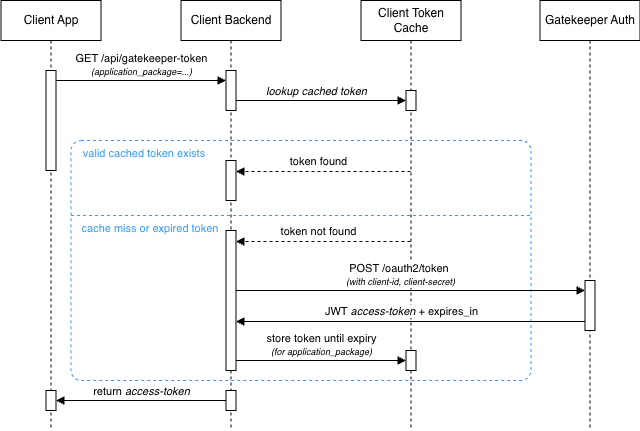 The sequence diagram illustrates how your Client App obtains a JWT access token required to initialize the Gatekeeper SDK, while ensuring that your Client Backend does not request a new token from the Gatekeeper Auth Server unnecessarily.
1. **Token request from the Client App** Your Client App (iOS, Android, or Web) requests a Gatekeeper JWT access token from your Client Backend through the `/api/gatekeeper-token` endpoint. The `application_package` parameter identifies the application for which the token is required.
2. **Check the token cache** Your Client Backend checks the Token Cache for an existing access token associated with the specified `application_package`.
3. **Use a valid cached token** If a valid, non-expired token is found in the cache, your Client Backend retrieves it and uses it to fulfill your Client App’s request. No request to the Gatekeeper Auth Server is required.
4. **Obtain a new token when necessary** If no valid token is available — for example, because the token is missing from the cache or has expired — your Client Backend requests a new JWT access token from the Gatekeeper Auth Server using the OAuth 2.0 Client Credentials flow via the `/oauth2/token` endpoint (see [OAuth 2.0 Client Credentials Flow](https://docs.bespot.com/api/auth)).
5. **Cache the new token** The Gatekeeper Auth Server returns the JWT access token together with its `expires_in` value. Your Client Backend should store the token in your Token Cache and keeps it available until its expiry.
6. **Return the token to the Client App** Your Client Backend returns the JWT access token to your Client App, regardless of whether the token was retrieved from the cache or newly obtained from the Gatekeeper Auth Server.
Finally, your Client App initializes the Gatekeeper SDK using the JWT access token. The Gatekeeper SDK can then use this token when communicating with Gatekeeper services in order to be authorized to access resources.
This caching mechanism reduces unnecessary authentication requests to the Gatekeeper Auth Server, speeds up the response times and allows multiple requests from the Client App to reuse the same valid access token - for the specific *`application_package`* - until it expires.
## Endpoint Specification
### Resource \[GET]
`[{CLIENT_SERVER_URL}/api/gatekeeper-token]`
Replace `{CLIENT_SERVER_URL}` with your application’s backend url.
### Query Parameters
| Parameter | Type | Required | Description |
| :-------------------- | :----- | :------- | :----------------------------------------------------------------------------------------------------------------------------------------------------------------------------------------------------------------------------------------------------- |
| `application_package` | string | Yes | Identifies the client application requesting the token. Use the **Android application package name** (e.g. `com.example.myapp`), the **iOS bundle identifier** (e.g. `com.example.MyApp`), or the **Web application domain** (e.g. `app.example.com`). |
Your backend uses this value to select the correct OAuth 2.0 client credentials for the corresponding platform.
### Response
**Status:** `200 OK`
**Body**
Return the JWT access token formatted in JSON.
JSON:
```json theme={null}
{
"access_token": "{JWT-ACCESS-TOKEN}"
}
```
### Error Responses
Return appropriate HTTP status codes when:
* `application_package` is missing or unknown (`400 Bad Request`)
* Gatekeeper credentials for the given application are not configured (`401 Unauthorized`)
* The Gatekeeper auth server rejects the request (`502 Bad Gateway` or `503 Service Unavailable`)
## Backend Responsibilities
1. **Store credentials securely.** Keep the `AUTH_SERVER_URL`, `client_id`, and `client_secret` for each application platform in a secure store (environment variables, secrets manager, or encrypted configuration). Never expose them to client applications.
2. **Map `application_package` to credentials.** Maintain a lookup from the incoming `application_package`value to the OAuth 2.0 credentials registered with Gatekeeper for that platform.
3. **Acquire a JWT from Gatekeeper.** When no valid cached token is available, request a new access token from `{AUTH_SERVER_URL}/oauth2/token` as described in [Authenticate with Gatekeeper](https://docs.bespot.com/api/auth).
4. **Cache valid tokens.** Client applications may call this endpoint frequently. Cache each JWT until it expires. Use the `expires_in` value from the Gatekeeper auth response, or decode the JWT and read the `exp` claim. Invalidate the cache entry when the token expires and request a fresh token on the next call.
## Caching Strategy
* **Cache key:** Use `application_package` as the cache key so each platform/application has its own token.
* **TTL:** Set the cache entry lifetime to the token’s remaining validity. Subtract a small safety margin (e.g. 30–60 seconds) from `expires_in` to avoid returning a token that expires before the SDK uses it.
* **Invalidation:** When a cached token expires, discard it and fetch a new one from Gatekeeper on the next request.
* **Storage:** An in-memory cache is sufficient for a single-instance backend. Use a shared cache (e.g. Redis) if your backend runs on multiple instances.
## Code Examples
The examples below implement a `GET /api/gatekeeper-token` endpoint with token caching. Replace placeholder values with the Gatekeeper auth server URL and credentials provided in [Gatekeeper](https://gatekeeper.bespot.com/) platform.
```python theme={null}
import base64
import time
from dataclasses import dataclass
from typing import Dict, Optional
import requests
from flask import Flask, request, jsonify
app = Flask(__name__)
AUTH_SERVER_URL = "https://auth.example.com"
CREDENTIALS_BY_PACKAGE: Dict[str, Dict[str, str]] = {
"com.example.myapp": {
"client_id": "android-client-id",
"client_secret": "android-client-secret",
},
"com.example.MyApp": {
"client_id": "ios-client-id",
"client_secret": "ios-client-secret",
},
"app.example.com": {
"client_id": "web-client-id",
"client_secret": "web-client-secret",
},
}
CACHE_SAFETY_MARGIN_SECONDS = 60
@dataclass
class CachedToken:
access_token: str
expires_at: float
token_cache: Dict[str, CachedToken] = {}
def fetch_gatekeeper_token(client_id: str, client_secret: str) -> CachedToken:
credentials = f"{client_id}:{client_secret}".encode("utf-8")
authorization = base64.b64encode(credentials).decode("utf-8")
response = requests.post(
f"{AUTH_SERVER_URL}/oauth2/token",
headers={
"Content-Type": "application/x-www-form-urlencoded",
"Authorization": f"Basic {authorization}",
},
data={"grant_type": "client_credentials"},
timeout=10,
)
response.raise_for_status()
payload = response.json()
expires_in = int(payload["expires_in"])
expires_at = time.time() + max(expires_in - CACHE_SAFETY_MARGIN_SECONDS, 0)
return CachedToken(
access_token=payload["access_token"],
expires_at=expires_at,
)
def get_cached_token(application_package: str) -> str:
cached = token_cache.get(application_package)
if cached and cached.expires_at > time.time():
return cached.access_token
credentials = CREDENTIALS_BY_PACKAGE.get(application_package)
if not credentials:
raise KeyError(f"Unknown application_package: {application_package}")
cached = fetch_gatekeeper_token(
credentials["client_id"],
credentials["client_secret"],
)
token_cache[application_package] = cached
return cached.access_token
@app.get("/api/gatekeeper-token")
def gatekeeper_token():
application_package = request.args.get("application_package")
if not application_package:
return jsonify({"error": "application_package is required"}), 400
try:
access_token = get_cached_token(application_package)
except KeyError as exc:
return jsonify({"error": str(exc)}), 400
except requests.RequestException:
return jsonify({"error": "Failed to acquire token from Gatekeeper"}), 502
return jsonify({"access_token": access_token})
```
```kotlin theme={null}
import io.ktor.client.*
import io.ktor.client.call.*
import io.ktor.client.engine.cio.*
import io.ktor.client.plugins.contentnegotiation.*
import io.ktor.client.request.*
import io.ktor.client.request.forms.*
import io.ktor.http.*
import io.ktor.serialization.kotlinx.json.*
import io.ktor.server.application.*
import io.ktor.server.engine.*
import io.ktor.server.netty.*
import io.ktor.server.response.*
import io.ktor.server.routing.*
import kotlinx.serialization.Serializable
import java.time.Instant
import java.util.Base64
import java.util.concurrent.ConcurrentHashMap
private const val AUTH_SERVER_URL = "https://auth.example.com"
private const val CACHE_SAFETY_MARGIN_SECONDS = 60L
private val credentialsByPackage = mapOf(
"com.example.myapp" to ClientCredentials("android-client-id", "android-client-secret"),
"com.example.MyApp" to ClientCredentials("ios-client-id", "ios-client-secret"),
"app.example.com" to ClientCredentials("web-client-id", "web-client-secret"),
)
data class ClientCredentials(val clientId: String, val clientSecret: String)
data class CachedToken(val accessToken: String, val expiresAt: Instant)
@Serializable
data class TokenResponse(val access_token: String, val expires_in: Long)
@Serializable
data class GatekeeperTokenResponse(val access_token: String)
private val tokenCache = ConcurrentHashMap()
private val httpClient = HttpClient(CIO) {
install(ContentNegotiation) { json() }
}
suspend fun fetchGatekeeperToken(credentials: ClientCredentials): CachedToken {
val basicAuth = Base64.getEncoder().encodeToString(
"${credentials.clientId}:${credentials.clientSecret}".toByteArray()
)
val response: TokenResponse = httpClient.post("$AUTH_SERVER_URL/oauth2/token") {
header(HttpHeaders.Authorization, "Basic $basicAuth")
contentType(ContentType.Application.FormUrlEncoded)
setBody(FormDataContent(Parameters.build {
append("grant_type", "client_credentials")
}))
}.body()
val expiresAt = Instant.now().plusSeconds(
maxOf(response.expires_in - CACHE_SAFETY_MARGIN_SECONDS, 0)
)
return CachedToken(response.access_token, expiresAt)
}
suspend fun getCachedToken(applicationPackage: String): String {
val cached = tokenCache[applicationPackage]
if (cached != null && cached.expiresAt.isAfter(Instant.now())) {
return cached.accessToken
}
val credentials = credentialsByPackage[applicationPackage]
?: error("Unknown application_package: $applicationPackage")
val freshToken = fetchGatekeeperToken(credentials)
tokenCache[applicationPackage] = freshToken
return freshToken.accessToken
}
fun main() {
embeddedServer(Netty, port = 8080) {
routing {
get("/api/gatekeeper-token") {
val applicationPackage = call.request.queryParameters["application_package"]
if (applicationPackage.isNullOrBlank()) {
call.respond(HttpStatusCode.BadRequest, mapOf("error" to "application_package is required"))
return@get
}
try {
val accessToken = getCachedToken(applicationPackage)
call.respond(GatekeeperTokenResponse(accessToken))
} catch (error: IllegalStateException) {
call.respond(HttpStatusCode.BadRequest, mapOf("error" to error.message))
} catch (error: Exception) {
call.respond(HttpStatusCode.BadGateway, mapOf("error" to "Failed to acquire token from Gatekeeper"))
}
}
}
}.start(wait = true)
}
```
```java theme={null}
import org.springframework.http.*;
import org.springframework.util.LinkedMultiValueMap;
import org.springframework.util.MultiValueMap;
import org.springframework.web.bind.annotation.*;
import org.springframework.web.client.RestClientException;
import org.springframework.web.client.RestTemplate;
import java.nio.charset.StandardCharsets;
import java.time.Instant;
import java.util.Base64;
import java.util.Map;
import java.util.concurrent.ConcurrentHashMap;
@RestController
public class GatekeeperTokenController {
private static final String AUTH_SERVER_URL = "https://auth.example.com";
private static final long CACHE_SAFETY_MARGIN_SECONDS = 60;
private final RestTemplate restTemplate = new RestTemplate();
private final Map credentialsByPackage = Map.of(
"com.example.myapp", new ClientCredentials("android-client-id", "android-client-secret"),
"com.example.MyApp", new ClientCredentials("ios-client-id", "ios-client-secret"),
"app.example.com", new ClientCredentials("web-client-id", "web-client-secret")
);
private final Map tokenCache = new ConcurrentHashMap<>();
@GetMapping("/api/gatekeeper-token")
public ResponseEntity gatekeeperToken(@RequestParam(value = "application_package", required = false) String applicationPackage) {
if (applicationPackage == null || applicationPackage.isBlank()) {
return ResponseEntity.badRequest().body(Map.of("error", "application_package is required"));
}
ClientCredentials credentials = credentialsByPackage.get(applicationPackage);
if (credentials == null) {
return ResponseEntity.badRequest().body(Map.of("error", "Unknown application_package: " + applicationPackage));
}
try {
String accessToken = getCachedToken(applicationPackage, credentials);
return ResponseEntity.ok(Map.of("access_token", accessToken));
} catch (RestClientException ex) {
return ResponseEntity.status(HttpStatus.BAD_GATEWAY)
.body(Map.of("error", "Failed to acquire token from Gatekeeper"));
}
}
private String getCachedToken(String applicationPackage, ClientCredentials credentials) {
CachedToken cached = tokenCache.get(applicationPackage);
if (cached != null && cached.expiresAt().isAfter(Instant.now())) {
return cached.accessToken();
}
CachedToken freshToken = fetchGatekeeperToken(credentials);
tokenCache.put(applicationPackage, freshToken);
return freshToken.accessToken();
}
private CachedToken fetchGatekeeperToken(ClientCredentials credentials) {
String basicAuth = Base64.getEncoder().encodeToString(
(credentials.clientId() + ":" + credentials.clientSecret()).getBytes(StandardCharsets.UTF_8)
);
HttpHeaders headers = new HttpHeaders();
headers.setContentType(MediaType.APPLICATION_FORM_URLENCODED);
headers.set(HttpHeaders.AUTHORIZATION, "Basic " + basicAuth);
MultiValueMap body = new LinkedMultiValueMap<>();
body.add("grant_type", "client_credentials");
ResponseEntity response = restTemplate.exchange(
AUTH_SERVER_URL + "/oauth2/token",
HttpMethod.POST,
new HttpEntity<>(body, headers),
TokenResponse.class
);
TokenResponse tokenResponse = response.getBody();
if (tokenResponse == null || tokenResponse.accessToken() == null) {
throw new RestClientException("Empty token response from Gatekeeper");
}
Instant expiresAt = Instant.now().plusSeconds(
Math.max(tokenResponse.expiresIn() - CACHE_SAFETY_MARGIN_SECONDS, 0)
);
return new CachedToken(tokenResponse.accessToken(), expiresAt);
}
private record ClientCredentials(String clientId, String clientSecret) {}
private record CachedToken(String accessToken, Instant expiresAt) {}
private record TokenResponse(String accessToken, long expiresIn) {}
}
```
```ruby theme={null}
require "sinatra"
require "net/http"
require "json"
require "base64"
require "uri"
AUTH_SERVER_URL = "https://auth.example.com"
CACHE_SAFETY_MARGIN_SECONDS = 60
CREDENTIALS_BY_PACKAGE = {
"com.example.myapp" => { client_id: "android-client-id", client_secret: "android-client-secret" },
"com.example.MyApp" => { client_id: "ios-client-id", client_secret: "ios-client-secret" },
"app.example.com" => { client_id: "web-client-id", client_secret: "web-client-secret" }
}.freeze
$token_cache = {}
def fetch_gatekeeper_token(client_id, client_secret)
uri = URI("#{AUTH_SERVER_URL}/oauth2/token")
request = Net::HTTP::Post.new(uri)
request["Content-Type"] = "application/x-www-form-urlencoded"
request["Authorization"] = "Basic #{Base64.strict_encode64("#{client_id}:#{client_secret}")}"
request.body = URI.encode_www_form(grant_type: "client_credentials")
response = Net::HTTP.start(uri.hostname, uri.port, use_ssl: uri.scheme == "https") do |http|
http.request(request)
end
raise "Gatekeeper auth failed: #{response.code}" unless response.is_a?(Net::HTTPSuccess)
payload = JSON.parse(response.body)
expires_at = Time.now.to_i + [payload["expires_in"].to_i - CACHE_SAFETY_MARGIN_SECONDS, 0].max
{
access_token: payload["access_token"],
expires_at: expires_at
}
end
def get_cached_token(application_package)
cached = $token_cache[application_package]
return cached[:access_token] if cached && cached[:expires_at] > Time.now.to_i
credentials = CREDENTIALS_BY_PACKAGE[application_package]
raise ArgumentError, "Unknown application_package: #{application_package}" unless credentials
fresh_token = fetch_gatekeeper_token(credentials[:client_id], credentials[:client_secret])
$token_cache[application_package] = fresh_token
fresh_token[:access_token]
end
get "/api/gatekeeper-token" do
content_type :json
application_package = params["application_package"]
halt 400, { error: "application_package is required" }.to_json if application_package.nil? || application_package.empty?
begin
access_token = get_cached_token(application_package)
{ access_token: access_token }.to_json
rescue ArgumentError => e
halt 400, { error: e.message }.to_json
rescue StandardError
halt 502, { error: "Failed to acquire token from Gatekeeper" }.to_json
end
end
```
```go theme={null}
package main
import (
"encoding/base64"
"encoding/json"
"errors"
"fmt"
"io"
"net/http"
"net/url"
"strings"
"sync"
"time"
)
const (
authServerURL = "https://auth.example.com"
cacheSafetyMargin = 60 * time.Second
)
type clientCredentials struct {
ClientID string
ClientSecret string
}
type cachedToken struct {
AccessToken string
ExpiresAt time.Time
}
type tokenResponse struct {
AccessToken string `json:"access_token"`
ExpiresIn int64 `json:"expires_in"`
}
var (
credentialsByPackage = map[string]clientCredentials{
"com.example.myapp": {ClientID: "android-client-id", ClientSecret: "android-client-secret"},
"com.example.MyApp": {ClientID: "ios-client-id", ClientSecret: "ios-client-secret"},
"app.example.com": {ClientID: "web-client-id", ClientSecret: "web-client-secret"},
}
tokenCache = struct {
sync.RWMutex
entries map[string]cachedToken
}{
entries: make(map[string]cachedToken),
}
)
func fetchGatekeeperToken(credentials clientCredentials) (cachedToken, error) {
form := url.Values{}
form.Set("grant_type", "client_credentials")
req, err := http.NewRequest(http.MethodPost, authServerURL+"/oauth2/token", strings.NewReader(form.Encode()))
if err != nil {
return cachedToken{}, err
}
basicAuth := base64.StdEncoding.EncodeToString(
[]byte(credentials.ClientID + ":" + credentials.ClientSecret),
)
req.Header.Set("Content-Type", "application/x-www-form-urlencoded")
req.Header.Set("Authorization", "Basic "+basicAuth)
resp, err := http.DefaultClient.Do(req)
if err != nil {
return cachedToken{}, err
}
defer resp.Body.Close()
if resp.StatusCode != http.StatusOK {
body, _ := io.ReadAll(resp.Body)
return cachedToken{}, fmt.Errorf("gatekeeper auth failed: %s", string(body))
}
var payload tokenResponse
if err := json.NewDecoder(resp.Body).Decode(&payload); err != nil {
return cachedToken{}, err
}
expiresAt := time.Now().Add(time.Duration(payload.ExpiresIn)*time.Second - cacheSafetyMargin)
if expiresAt.Before(time.Now()) {
expiresAt = time.Now()
}
return cachedToken{
AccessToken: payload.AccessToken,
ExpiresAt: expiresAt,
}, nil
}
func getCachedToken(applicationPackage string) (string, error) {
tokenCache.RLock()
cached, ok := tokenCache.entries[applicationPackage]
tokenCache.RUnlock()
if ok && time.Now().Before(cached.ExpiresAt) {
return cached.AccessToken, nil
}
credentials, ok := credentialsByPackage[applicationPackage]
if !ok {
return "", fmt.Errorf("unknown application_package: %s", applicationPackage)
}
freshToken, err := fetchGatekeeperToken(credentials)
if err != nil {
return "", err
}
tokenCache.Lock()
tokenCache.entries[applicationPackage] = freshToken
tokenCache.Unlock()
return freshToken.AccessToken, nil
}
func gatekeeperTokenHandler(w http.ResponseWriter, r *http.Request) {
applicationPackage := r.URL.Query().Get("application_package")
if applicationPackage == "" {
writeJSON(w, http.StatusBadRequest, map[string]string{"error": "application_package is required"})
return
}
accessToken, err := getCachedToken(applicationPackage)
if err != nil {
if strings.Contains(err.Error(), "unknown application_package") {
writeJSON(w, http.StatusBadRequest, map[string]string{"error": err.Error()})
return
}
writeJSON(w, http.StatusBadGateway, map[string]string{"error": "Failed to acquire token from Gatekeeper"})
return
}
writeJSON(w, http.StatusOK, map[string]string{"access_token": accessToken})
}
func writeJSON(w http.ResponseWriter, status int, payload any) {
w.Header().Set("Content-Type", "application/json")
w.WriteHeader(status)
_ = json.NewEncoder(w).Encode(payload)
}
func main() {
http.HandleFunc("/api/gatekeeper-token", gatekeeperTokenHandler)
if err := http.ListenAndServe(":8080", nil); err != nil && !errors.Is(err, http.ErrServerClosed) {
panic(err)
}
}
```
```rust theme={null}
use axum::{
extract::Query,
http::StatusCode,
response::{IntoResponse, Response},
routing::get,
Json, Router,
};
use base64::{engine::general_purpose::STANDARD, Engine};
use reqwest::header::{AUTHORIZATION, CONTENT_TYPE};
use serde::{Deserialize, Serialize};
use std::{
collections::HashMap,
sync::{Arc, RwLock},
time::{Duration, Instant},
};
use tokio::net::TcpListener;
const AUTH_SERVER_URL: &str = "https://auth.example.com";
const CACHE_SAFETY_MARGIN: Duration = Duration::from_secs(60);
#[derive(Clone)]
struct ClientCredentials {
client_id: String,
client_secret: String,
}
#[derive(Clone)]
struct CachedToken {
access_token: String,
expires_at: Instant,
}
#[derive(Clone)]
struct AppState {
credentials_by_package: HashMap,
token_cache: Arc>>,
http_client: reqwest::Client,
}
#[derive(Deserialize)]
struct TokenQuery {
application_package: Option,
}
#[derive(Deserialize)]
struct TokenResponse {
access_token: String,
expires_in: u64,
}
#[derive(Serialize)]
struct GatekeeperTokenResponse {
access_token: String,
}
#[derive(Serialize)]
struct ErrorResponse {
error: String,
}
async fn fetch_gatekeeper_token(
http_client: &reqwest::Client,
credentials: &ClientCredentials,
) -> Result {
let basic_auth = STANDARD.encode(format!(
"{}:{}",
credentials.client_id, credentials.client_secret
));
let response = http_client
.post(format!("{AUTH_SERVER_URL}/oauth2/token"))
.header(CONTENT_TYPE, "application/x-www-form-urlencoded")
.header(AUTHORIZATION, format!("Basic {basic_auth}"))
.body("grant_type=client_credentials")
.send()
.await?
.error_for_status()?
.json::()
.await?;
let ttl = Duration::from_secs(response.expires_in).saturating_sub(CACHE_SAFETY_MARGIN);
Ok(CachedToken {
access_token: response.access_token,
expires_at: Instant::now() + ttl,
})
}
async fn get_cached_token(
state: &AppState,
application_package: &str,
) -> Result {
{
let cache = state.token_cache.read().unwrap();
if let Some(cached) = cache.get(application_package) {
if cached.expires_at > Instant::now() {
return Ok(cached.access_token.clone());
}
}
}
let credentials = state
.credentials_by_package
.get(application_package)
.cloned()
.ok_or_else(|| format!("Unknown application_package: {application_package}"))?;
let fresh_token = fetch_gatekeeper_token(&state.http_client, &credentials)
.await
.map_err(|_| "Failed to acquire token from Gatekeeper".to_string())?;
let access_token = fresh_token.access_token.clone();
state
.token_cache
.write()
.unwrap()
.insert(application_package.to_string(), fresh_token);
Ok(access_token)
}
async fn gatekeeper_token_handler(
axum::extract::State(state): axum::extract::State,
Query(query): Query,
) -> Response {
let Some(application_package) = query.application_package.filter(|value| !value.is_empty()) else {
return (
StatusCode::BAD_REQUEST,
Json(ErrorResponse {
error: "application_package is required".to_string(),
}),
)
.into_response();
};
match get_cached_token(&state, &application_package).await {
Ok(access_token) => (
StatusCode::OK,
Json(GatekeeperTokenResponse { access_token }),
)
.into_response(),
Err(message) if message.starts_with("Unknown application_package") => (
StatusCode::BAD_REQUEST,
Json(ErrorResponse { error: message }),
)
.into_response(),
Err(_) => (
StatusCode::BAD_GATEWAY,
Json(ErrorResponse {
error: "Failed to acquire token from Gatekeeper".to_string(),
}),
)
.into_response(),
}
}
#[tokio::main]
async fn main() {
let mut credentials_by_package = HashMap::new();
credentials_by_package.insert(
"com.example.myapp".to_string(),
ClientCredentials {
client_id: "android-client-id".to_string(),
client_secret: "android-client-secret".to_string(),
},
);
credentials_by_package.insert(
"com.example.MyApp".to_string(),
ClientCredentials {
client_id: "ios-client-id".to_string(),
client_secret: "ios-client-secret".to_string(),
},
);
credentials_by_package.insert(
"app.example.com".to_string(),
ClientCredentials {
client_id: "web-client-id".to_string(),
client_secret: "web-client-secret".to_string(),
},
);
let state = AppState {
credentials_by_package,
token_cache: Arc::new(RwLock::new(HashMap::new())),
http_client: reqwest::Client::new(),
};
let app = Router::new()
.route("/api/gatekeeper-token", get(gatekeeper_token_handler))
.with_state(state);
let listener = TcpListener::bind("0.0.0.0:8080").await.unwrap();
axum::serve(listener, app).await.unwrap();
}
```
Code examples above are **AI generated**. Consult your development team to integrate the new endpoint properly in your backend code.
The sequence diagram illustrates how your Client App obtains a JWT access token required to initialize the Gatekeeper SDK, while ensuring that your Client Backend does not request a new token from the Gatekeeper Auth Server unnecessarily.
1. **Token request from the Client App** Your Client App (iOS, Android, or Web) requests a Gatekeeper JWT access token from your Client Backend through the `/api/gatekeeper-token` endpoint. The `application_package` parameter identifies the application for which the token is required.
2. **Check the token cache** Your Client Backend checks the Token Cache for an existing access token associated with the specified `application_package`.
3. **Use a valid cached token** If a valid, non-expired token is found in the cache, your Client Backend retrieves it and uses it to fulfill your Client App’s request. No request to the Gatekeeper Auth Server is required.
4. **Obtain a new token when necessary** If no valid token is available — for example, because the token is missing from the cache or has expired — your Client Backend requests a new JWT access token from the Gatekeeper Auth Server using the OAuth 2.0 Client Credentials flow via the `/oauth2/token` endpoint (see [OAuth 2.0 Client Credentials Flow](https://docs.bespot.com/api/auth)).
5. **Cache the new token** The Gatekeeper Auth Server returns the JWT access token together with its `expires_in` value. Your Client Backend should store the token in your Token Cache and keeps it available until its expiry.
6. **Return the token to the Client App** Your Client Backend returns the JWT access token to your Client App, regardless of whether the token was retrieved from the cache or newly obtained from the Gatekeeper Auth Server.
Finally, your Client App initializes the Gatekeeper SDK using the JWT access token. The Gatekeeper SDK can then use this token when communicating with Gatekeeper services in order to be authorized to access resources.
This caching mechanism reduces unnecessary authentication requests to the Gatekeeper Auth Server, speeds up the response times and allows multiple requests from the Client App to reuse the same valid access token - for the specific *`application_package`* - until it expires.
## Endpoint Specification
### Resource \[GET]
`[{CLIENT_SERVER_URL}/api/gatekeeper-token]`
Replace `{CLIENT_SERVER_URL}` with your application’s backend url.
### Query Parameters
| Parameter | Type | Required | Description |
| :-------------------- | :----- | :------- | :----------------------------------------------------------------------------------------------------------------------------------------------------------------------------------------------------------------------------------------------------- |
| `application_package` | string | Yes | Identifies the client application requesting the token. Use the **Android application package name** (e.g. `com.example.myapp`), the **iOS bundle identifier** (e.g. `com.example.MyApp`), or the **Web application domain** (e.g. `app.example.com`). |
Your backend uses this value to select the correct OAuth 2.0 client credentials for the corresponding platform.
### Response
**Status:** `200 OK`
**Body**
Return the JWT access token formatted in JSON.
JSON:
```json theme={null}
{
"access_token": "{JWT-ACCESS-TOKEN}"
}
```
### Error Responses
Return appropriate HTTP status codes when:
* `application_package` is missing or unknown (`400 Bad Request`)
* Gatekeeper credentials for the given application are not configured (`401 Unauthorized`)
* The Gatekeeper auth server rejects the request (`502 Bad Gateway` or `503 Service Unavailable`)
## Backend Responsibilities
1. **Store credentials securely.** Keep the `AUTH_SERVER_URL`, `client_id`, and `client_secret` for each application platform in a secure store (environment variables, secrets manager, or encrypted configuration). Never expose them to client applications.
2. **Map `application_package` to credentials.** Maintain a lookup from the incoming `application_package`value to the OAuth 2.0 credentials registered with Gatekeeper for that platform.
3. **Acquire a JWT from Gatekeeper.** When no valid cached token is available, request a new access token from `{AUTH_SERVER_URL}/oauth2/token` as described in [Authenticate with Gatekeeper](https://docs.bespot.com/api/auth).
4. **Cache valid tokens.** Client applications may call this endpoint frequently. Cache each JWT until it expires. Use the `expires_in` value from the Gatekeeper auth response, or decode the JWT and read the `exp` claim. Invalidate the cache entry when the token expires and request a fresh token on the next call.
## Caching Strategy
* **Cache key:** Use `application_package` as the cache key so each platform/application has its own token.
* **TTL:** Set the cache entry lifetime to the token’s remaining validity. Subtract a small safety margin (e.g. 30–60 seconds) from `expires_in` to avoid returning a token that expires before the SDK uses it.
* **Invalidation:** When a cached token expires, discard it and fetch a new one from Gatekeeper on the next request.
* **Storage:** An in-memory cache is sufficient for a single-instance backend. Use a shared cache (e.g. Redis) if your backend runs on multiple instances.
## Code Examples
The examples below implement a `GET /api/gatekeeper-token` endpoint with token caching. Replace placeholder values with the Gatekeeper auth server URL and credentials provided in [Gatekeeper](https://gatekeeper.bespot.com/) platform.
```python theme={null}
import base64
import time
from dataclasses import dataclass
from typing import Dict, Optional
import requests
from flask import Flask, request, jsonify
app = Flask(__name__)
AUTH_SERVER_URL = "https://auth.example.com"
CREDENTIALS_BY_PACKAGE: Dict[str, Dict[str, str]] = {
"com.example.myapp": {
"client_id": "android-client-id",
"client_secret": "android-client-secret",
},
"com.example.MyApp": {
"client_id": "ios-client-id",
"client_secret": "ios-client-secret",
},
"app.example.com": {
"client_id": "web-client-id",
"client_secret": "web-client-secret",
},
}
CACHE_SAFETY_MARGIN_SECONDS = 60
@dataclass
class CachedToken:
access_token: str
expires_at: float
token_cache: Dict[str, CachedToken] = {}
def fetch_gatekeeper_token(client_id: str, client_secret: str) -> CachedToken:
credentials = f"{client_id}:{client_secret}".encode("utf-8")
authorization = base64.b64encode(credentials).decode("utf-8")
response = requests.post(
f"{AUTH_SERVER_URL}/oauth2/token",
headers={
"Content-Type": "application/x-www-form-urlencoded",
"Authorization": f"Basic {authorization}",
},
data={"grant_type": "client_credentials"},
timeout=10,
)
response.raise_for_status()
payload = response.json()
expires_in = int(payload["expires_in"])
expires_at = time.time() + max(expires_in - CACHE_SAFETY_MARGIN_SECONDS, 0)
return CachedToken(
access_token=payload["access_token"],
expires_at=expires_at,
)
def get_cached_token(application_package: str) -> str:
cached = token_cache.get(application_package)
if cached and cached.expires_at > time.time():
return cached.access_token
credentials = CREDENTIALS_BY_PACKAGE.get(application_package)
if not credentials:
raise KeyError(f"Unknown application_package: {application_package}")
cached = fetch_gatekeeper_token(
credentials["client_id"],
credentials["client_secret"],
)
token_cache[application_package] = cached
return cached.access_token
@app.get("/api/gatekeeper-token")
def gatekeeper_token():
application_package = request.args.get("application_package")
if not application_package:
return jsonify({"error": "application_package is required"}), 400
try:
access_token = get_cached_token(application_package)
except KeyError as exc:
return jsonify({"error": str(exc)}), 400
except requests.RequestException:
return jsonify({"error": "Failed to acquire token from Gatekeeper"}), 502
return jsonify({"access_token": access_token})
```
```kotlin theme={null}
import io.ktor.client.*
import io.ktor.client.call.*
import io.ktor.client.engine.cio.*
import io.ktor.client.plugins.contentnegotiation.*
import io.ktor.client.request.*
import io.ktor.client.request.forms.*
import io.ktor.http.*
import io.ktor.serialization.kotlinx.json.*
import io.ktor.server.application.*
import io.ktor.server.engine.*
import io.ktor.server.netty.*
import io.ktor.server.response.*
import io.ktor.server.routing.*
import kotlinx.serialization.Serializable
import java.time.Instant
import java.util.Base64
import java.util.concurrent.ConcurrentHashMap
private const val AUTH_SERVER_URL = "https://auth.example.com"
private const val CACHE_SAFETY_MARGIN_SECONDS = 60L
private val credentialsByPackage = mapOf(
"com.example.myapp" to ClientCredentials("android-client-id", "android-client-secret"),
"com.example.MyApp" to ClientCredentials("ios-client-id", "ios-client-secret"),
"app.example.com" to ClientCredentials("web-client-id", "web-client-secret"),
)
data class ClientCredentials(val clientId: String, val clientSecret: String)
data class CachedToken(val accessToken: String, val expiresAt: Instant)
@Serializable
data class TokenResponse(val access_token: String, val expires_in: Long)
@Serializable
data class GatekeeperTokenResponse(val access_token: String)
private val tokenCache = ConcurrentHashMap()
private val httpClient = HttpClient(CIO) {
install(ContentNegotiation) { json() }
}
suspend fun fetchGatekeeperToken(credentials: ClientCredentials): CachedToken {
val basicAuth = Base64.getEncoder().encodeToString(
"${credentials.clientId}:${credentials.clientSecret}".toByteArray()
)
val response: TokenResponse = httpClient.post("$AUTH_SERVER_URL/oauth2/token") {
header(HttpHeaders.Authorization, "Basic $basicAuth")
contentType(ContentType.Application.FormUrlEncoded)
setBody(FormDataContent(Parameters.build {
append("grant_type", "client_credentials")
}))
}.body()
val expiresAt = Instant.now().plusSeconds(
maxOf(response.expires_in - CACHE_SAFETY_MARGIN_SECONDS, 0)
)
return CachedToken(response.access_token, expiresAt)
}
suspend fun getCachedToken(applicationPackage: String): String {
val cached = tokenCache[applicationPackage]
if (cached != null && cached.expiresAt.isAfter(Instant.now())) {
return cached.accessToken
}
val credentials = credentialsByPackage[applicationPackage]
?: error("Unknown application_package: $applicationPackage")
val freshToken = fetchGatekeeperToken(credentials)
tokenCache[applicationPackage] = freshToken
return freshToken.accessToken
}
fun main() {
embeddedServer(Netty, port = 8080) {
routing {
get("/api/gatekeeper-token") {
val applicationPackage = call.request.queryParameters["application_package"]
if (applicationPackage.isNullOrBlank()) {
call.respond(HttpStatusCode.BadRequest, mapOf("error" to "application_package is required"))
return@get
}
try {
val accessToken = getCachedToken(applicationPackage)
call.respond(GatekeeperTokenResponse(accessToken))
} catch (error: IllegalStateException) {
call.respond(HttpStatusCode.BadRequest, mapOf("error" to error.message))
} catch (error: Exception) {
call.respond(HttpStatusCode.BadGateway, mapOf("error" to "Failed to acquire token from Gatekeeper"))
}
}
}
}.start(wait = true)
}
```
```java theme={null}
import org.springframework.http.*;
import org.springframework.util.LinkedMultiValueMap;
import org.springframework.util.MultiValueMap;
import org.springframework.web.bind.annotation.*;
import org.springframework.web.client.RestClientException;
import org.springframework.web.client.RestTemplate;
import java.nio.charset.StandardCharsets;
import java.time.Instant;
import java.util.Base64;
import java.util.Map;
import java.util.concurrent.ConcurrentHashMap;
@RestController
public class GatekeeperTokenController {
private static final String AUTH_SERVER_URL = "https://auth.example.com";
private static final long CACHE_SAFETY_MARGIN_SECONDS = 60;
private final RestTemplate restTemplate = new RestTemplate();
private final Map credentialsByPackage = Map.of(
"com.example.myapp", new ClientCredentials("android-client-id", "android-client-secret"),
"com.example.MyApp", new ClientCredentials("ios-client-id", "ios-client-secret"),
"app.example.com", new ClientCredentials("web-client-id", "web-client-secret")
);
private final Map tokenCache = new ConcurrentHashMap<>();
@GetMapping("/api/gatekeeper-token")
public ResponseEntity gatekeeperToken(@RequestParam(value = "application_package", required = false) String applicationPackage) {
if (applicationPackage == null || applicationPackage.isBlank()) {
return ResponseEntity.badRequest().body(Map.of("error", "application_package is required"));
}
ClientCredentials credentials = credentialsByPackage.get(applicationPackage);
if (credentials == null) {
return ResponseEntity.badRequest().body(Map.of("error", "Unknown application_package: " + applicationPackage));
}
try {
String accessToken = getCachedToken(applicationPackage, credentials);
return ResponseEntity.ok(Map.of("access_token", accessToken));
} catch (RestClientException ex) {
return ResponseEntity.status(HttpStatus.BAD_GATEWAY)
.body(Map.of("error", "Failed to acquire token from Gatekeeper"));
}
}
private String getCachedToken(String applicationPackage, ClientCredentials credentials) {
CachedToken cached = tokenCache.get(applicationPackage);
if (cached != null && cached.expiresAt().isAfter(Instant.now())) {
return cached.accessToken();
}
CachedToken freshToken = fetchGatekeeperToken(credentials);
tokenCache.put(applicationPackage, freshToken);
return freshToken.accessToken();
}
private CachedToken fetchGatekeeperToken(ClientCredentials credentials) {
String basicAuth = Base64.getEncoder().encodeToString(
(credentials.clientId() + ":" + credentials.clientSecret()).getBytes(StandardCharsets.UTF_8)
);
HttpHeaders headers = new HttpHeaders();
headers.setContentType(MediaType.APPLICATION_FORM_URLENCODED);
headers.set(HttpHeaders.AUTHORIZATION, "Basic " + basicAuth);
MultiValueMap body = new LinkedMultiValueMap<>();
body.add("grant_type", "client_credentials");
ResponseEntity response = restTemplate.exchange(
AUTH_SERVER_URL + "/oauth2/token",
HttpMethod.POST,
new HttpEntity<>(body, headers),
TokenResponse.class
);
TokenResponse tokenResponse = response.getBody();
if (tokenResponse == null || tokenResponse.accessToken() == null) {
throw new RestClientException("Empty token response from Gatekeeper");
}
Instant expiresAt = Instant.now().plusSeconds(
Math.max(tokenResponse.expiresIn() - CACHE_SAFETY_MARGIN_SECONDS, 0)
);
return new CachedToken(tokenResponse.accessToken(), expiresAt);
}
private record ClientCredentials(String clientId, String clientSecret) {}
private record CachedToken(String accessToken, Instant expiresAt) {}
private record TokenResponse(String accessToken, long expiresIn) {}
}
```
```ruby theme={null}
require "sinatra"
require "net/http"
require "json"
require "base64"
require "uri"
AUTH_SERVER_URL = "https://auth.example.com"
CACHE_SAFETY_MARGIN_SECONDS = 60
CREDENTIALS_BY_PACKAGE = {
"com.example.myapp" => { client_id: "android-client-id", client_secret: "android-client-secret" },
"com.example.MyApp" => { client_id: "ios-client-id", client_secret: "ios-client-secret" },
"app.example.com" => { client_id: "web-client-id", client_secret: "web-client-secret" }
}.freeze
$token_cache = {}
def fetch_gatekeeper_token(client_id, client_secret)
uri = URI("#{AUTH_SERVER_URL}/oauth2/token")
request = Net::HTTP::Post.new(uri)
request["Content-Type"] = "application/x-www-form-urlencoded"
request["Authorization"] = "Basic #{Base64.strict_encode64("#{client_id}:#{client_secret}")}"
request.body = URI.encode_www_form(grant_type: "client_credentials")
response = Net::HTTP.start(uri.hostname, uri.port, use_ssl: uri.scheme == "https") do |http|
http.request(request)
end
raise "Gatekeeper auth failed: #{response.code}" unless response.is_a?(Net::HTTPSuccess)
payload = JSON.parse(response.body)
expires_at = Time.now.to_i + [payload["expires_in"].to_i - CACHE_SAFETY_MARGIN_SECONDS, 0].max
{
access_token: payload["access_token"],
expires_at: expires_at
}
end
def get_cached_token(application_package)
cached = $token_cache[application_package]
return cached[:access_token] if cached && cached[:expires_at] > Time.now.to_i
credentials = CREDENTIALS_BY_PACKAGE[application_package]
raise ArgumentError, "Unknown application_package: #{application_package}" unless credentials
fresh_token = fetch_gatekeeper_token(credentials[:client_id], credentials[:client_secret])
$token_cache[application_package] = fresh_token
fresh_token[:access_token]
end
get "/api/gatekeeper-token" do
content_type :json
application_package = params["application_package"]
halt 400, { error: "application_package is required" }.to_json if application_package.nil? || application_package.empty?
begin
access_token = get_cached_token(application_package)
{ access_token: access_token }.to_json
rescue ArgumentError => e
halt 400, { error: e.message }.to_json
rescue StandardError
halt 502, { error: "Failed to acquire token from Gatekeeper" }.to_json
end
end
```
```go theme={null}
package main
import (
"encoding/base64"
"encoding/json"
"errors"
"fmt"
"io"
"net/http"
"net/url"
"strings"
"sync"
"time"
)
const (
authServerURL = "https://auth.example.com"
cacheSafetyMargin = 60 * time.Second
)
type clientCredentials struct {
ClientID string
ClientSecret string
}
type cachedToken struct {
AccessToken string
ExpiresAt time.Time
}
type tokenResponse struct {
AccessToken string `json:"access_token"`
ExpiresIn int64 `json:"expires_in"`
}
var (
credentialsByPackage = map[string]clientCredentials{
"com.example.myapp": {ClientID: "android-client-id", ClientSecret: "android-client-secret"},
"com.example.MyApp": {ClientID: "ios-client-id", ClientSecret: "ios-client-secret"},
"app.example.com": {ClientID: "web-client-id", ClientSecret: "web-client-secret"},
}
tokenCache = struct {
sync.RWMutex
entries map[string]cachedToken
}{
entries: make(map[string]cachedToken),
}
)
func fetchGatekeeperToken(credentials clientCredentials) (cachedToken, error) {
form := url.Values{}
form.Set("grant_type", "client_credentials")
req, err := http.NewRequest(http.MethodPost, authServerURL+"/oauth2/token", strings.NewReader(form.Encode()))
if err != nil {
return cachedToken{}, err
}
basicAuth := base64.StdEncoding.EncodeToString(
[]byte(credentials.ClientID + ":" + credentials.ClientSecret),
)
req.Header.Set("Content-Type", "application/x-www-form-urlencoded")
req.Header.Set("Authorization", "Basic "+basicAuth)
resp, err := http.DefaultClient.Do(req)
if err != nil {
return cachedToken{}, err
}
defer resp.Body.Close()
if resp.StatusCode != http.StatusOK {
body, _ := io.ReadAll(resp.Body)
return cachedToken{}, fmt.Errorf("gatekeeper auth failed: %s", string(body))
}
var payload tokenResponse
if err := json.NewDecoder(resp.Body).Decode(&payload); err != nil {
return cachedToken{}, err
}
expiresAt := time.Now().Add(time.Duration(payload.ExpiresIn)*time.Second - cacheSafetyMargin)
if expiresAt.Before(time.Now()) {
expiresAt = time.Now()
}
return cachedToken{
AccessToken: payload.AccessToken,
ExpiresAt: expiresAt,
}, nil
}
func getCachedToken(applicationPackage string) (string, error) {
tokenCache.RLock()
cached, ok := tokenCache.entries[applicationPackage]
tokenCache.RUnlock()
if ok && time.Now().Before(cached.ExpiresAt) {
return cached.AccessToken, nil
}
credentials, ok := credentialsByPackage[applicationPackage]
if !ok {
return "", fmt.Errorf("unknown application_package: %s", applicationPackage)
}
freshToken, err := fetchGatekeeperToken(credentials)
if err != nil {
return "", err
}
tokenCache.Lock()
tokenCache.entries[applicationPackage] = freshToken
tokenCache.Unlock()
return freshToken.AccessToken, nil
}
func gatekeeperTokenHandler(w http.ResponseWriter, r *http.Request) {
applicationPackage := r.URL.Query().Get("application_package")
if applicationPackage == "" {
writeJSON(w, http.StatusBadRequest, map[string]string{"error": "application_package is required"})
return
}
accessToken, err := getCachedToken(applicationPackage)
if err != nil {
if strings.Contains(err.Error(), "unknown application_package") {
writeJSON(w, http.StatusBadRequest, map[string]string{"error": err.Error()})
return
}
writeJSON(w, http.StatusBadGateway, map[string]string{"error": "Failed to acquire token from Gatekeeper"})
return
}
writeJSON(w, http.StatusOK, map[string]string{"access_token": accessToken})
}
func writeJSON(w http.ResponseWriter, status int, payload any) {
w.Header().Set("Content-Type", "application/json")
w.WriteHeader(status)
_ = json.NewEncoder(w).Encode(payload)
}
func main() {
http.HandleFunc("/api/gatekeeper-token", gatekeeperTokenHandler)
if err := http.ListenAndServe(":8080", nil); err != nil && !errors.Is(err, http.ErrServerClosed) {
panic(err)
}
}
```
```rust theme={null}
use axum::{
extract::Query,
http::StatusCode,
response::{IntoResponse, Response},
routing::get,
Json, Router,
};
use base64::{engine::general_purpose::STANDARD, Engine};
use reqwest::header::{AUTHORIZATION, CONTENT_TYPE};
use serde::{Deserialize, Serialize};
use std::{
collections::HashMap,
sync::{Arc, RwLock},
time::{Duration, Instant},
};
use tokio::net::TcpListener;
const AUTH_SERVER_URL: &str = "https://auth.example.com";
const CACHE_SAFETY_MARGIN: Duration = Duration::from_secs(60);
#[derive(Clone)]
struct ClientCredentials {
client_id: String,
client_secret: String,
}
#[derive(Clone)]
struct CachedToken {
access_token: String,
expires_at: Instant,
}
#[derive(Clone)]
struct AppState {
credentials_by_package: HashMap,
token_cache: Arc>>,
http_client: reqwest::Client,
}
#[derive(Deserialize)]
struct TokenQuery {
application_package: Option,
}
#[derive(Deserialize)]
struct TokenResponse {
access_token: String,
expires_in: u64,
}
#[derive(Serialize)]
struct GatekeeperTokenResponse {
access_token: String,
}
#[derive(Serialize)]
struct ErrorResponse {
error: String,
}
async fn fetch_gatekeeper_token(
http_client: &reqwest::Client,
credentials: &ClientCredentials,
) -> Result {
let basic_auth = STANDARD.encode(format!(
"{}:{}",
credentials.client_id, credentials.client_secret
));
let response = http_client
.post(format!("{AUTH_SERVER_URL}/oauth2/token"))
.header(CONTENT_TYPE, "application/x-www-form-urlencoded")
.header(AUTHORIZATION, format!("Basic {basic_auth}"))
.body("grant_type=client_credentials")
.send()
.await?
.error_for_status()?
.json::()
.await?;
let ttl = Duration::from_secs(response.expires_in).saturating_sub(CACHE_SAFETY_MARGIN);
Ok(CachedToken {
access_token: response.access_token,
expires_at: Instant::now() + ttl,
})
}
async fn get_cached_token(
state: &AppState,
application_package: &str,
) -> Result {
{
let cache = state.token_cache.read().unwrap();
if let Some(cached) = cache.get(application_package) {
if cached.expires_at > Instant::now() {
return Ok(cached.access_token.clone());
}
}
}
let credentials = state
.credentials_by_package
.get(application_package)
.cloned()
.ok_or_else(|| format!("Unknown application_package: {application_package}"))?;
let fresh_token = fetch_gatekeeper_token(&state.http_client, &credentials)
.await
.map_err(|_| "Failed to acquire token from Gatekeeper".to_string())?;
let access_token = fresh_token.access_token.clone();
state
.token_cache
.write()
.unwrap()
.insert(application_package.to_string(), fresh_token);
Ok(access_token)
}
async fn gatekeeper_token_handler(
axum::extract::State(state): axum::extract::State,
Query(query): Query,
) -> Response {
let Some(application_package) = query.application_package.filter(|value| !value.is_empty()) else {
return (
StatusCode::BAD_REQUEST,
Json(ErrorResponse {
error: "application_package is required".to_string(),
}),
)
.into_response();
};
match get_cached_token(&state, &application_package).await {
Ok(access_token) => (
StatusCode::OK,
Json(GatekeeperTokenResponse { access_token }),
)
.into_response(),
Err(message) if message.starts_with("Unknown application_package") => (
StatusCode::BAD_REQUEST,
Json(ErrorResponse { error: message }),
)
.into_response(),
Err(_) => (
StatusCode::BAD_GATEWAY,
Json(ErrorResponse {
error: "Failed to acquire token from Gatekeeper".to_string(),
}),
)
.into_response(),
}
}
#[tokio::main]
async fn main() {
let mut credentials_by_package = HashMap::new();
credentials_by_package.insert(
"com.example.myapp".to_string(),
ClientCredentials {
client_id: "android-client-id".to_string(),
client_secret: "android-client-secret".to_string(),
},
);
credentials_by_package.insert(
"com.example.MyApp".to_string(),
ClientCredentials {
client_id: "ios-client-id".to_string(),
client_secret: "ios-client-secret".to_string(),
},
);
credentials_by_package.insert(
"app.example.com".to_string(),
ClientCredentials {
client_id: "web-client-id".to_string(),
client_secret: "web-client-secret".to_string(),
},
);
let state = AppState {
credentials_by_package,
token_cache: Arc::new(RwLock::new(HashMap::new())),
http_client: reqwest::Client::new(),
};
let app = Router::new()
.route("/api/gatekeeper-token", get(gatekeeper_token_handler))
.with_state(state);
let listener = TcpListener::bind("0.0.0.0:8080").await.unwrap();
axum::serve(listener, app).await.unwrap();
}
```
Code examples above are **AI generated**. Consult your development team to integrate the new endpoint properly in your backend code.